
Malachite is distinct. Its deep, vibrant green and hypnotic banding make it one of the most recognizable minerals on the market. However, its popularity has led to a surge in counterfeits, primarily made from polymer clay or resin. Whether you are a collector or looking for unique jewelry, understanding the malachite meaning requires knowing exactly what you are holding in your hand.
In this guide, we pivot from abstract spirituality to the physical reality of the stone. We will cover the cultural lore, but more importantly, we will teach you how to ensure your gemstone is the real deal.

The Cultural Malachite Meaning
Before we dissect the mineralogy, it helps to understand why this stone is so sought after. Historically, malachite has been revered as a "Stone of Transformation." In various cultural traditions, it is believed to absorb negative energies and pollutants from the atmosphere and the body.
Because of its lush green color, it is frequently associated with nature and growth. In modern energy healing circles, practitioners often link it to the Heart Chakra, viewing it as a tool for emotional balance. While we enjoy these stories, remember that these are personal beliefs, not medical facts. Always consult a doctor for health issues.
Real vs. Fake Malachite: A Buyer’s Checklist
The market is flooded with "reconstituted" or purely synthetic malachite. Fortunately, spotting a fake is straightforward once you know what to look for. If you have been reading our crystal guide for beginners, you know that natural stones are rarely perfect.
1. The Pattern (Banding)
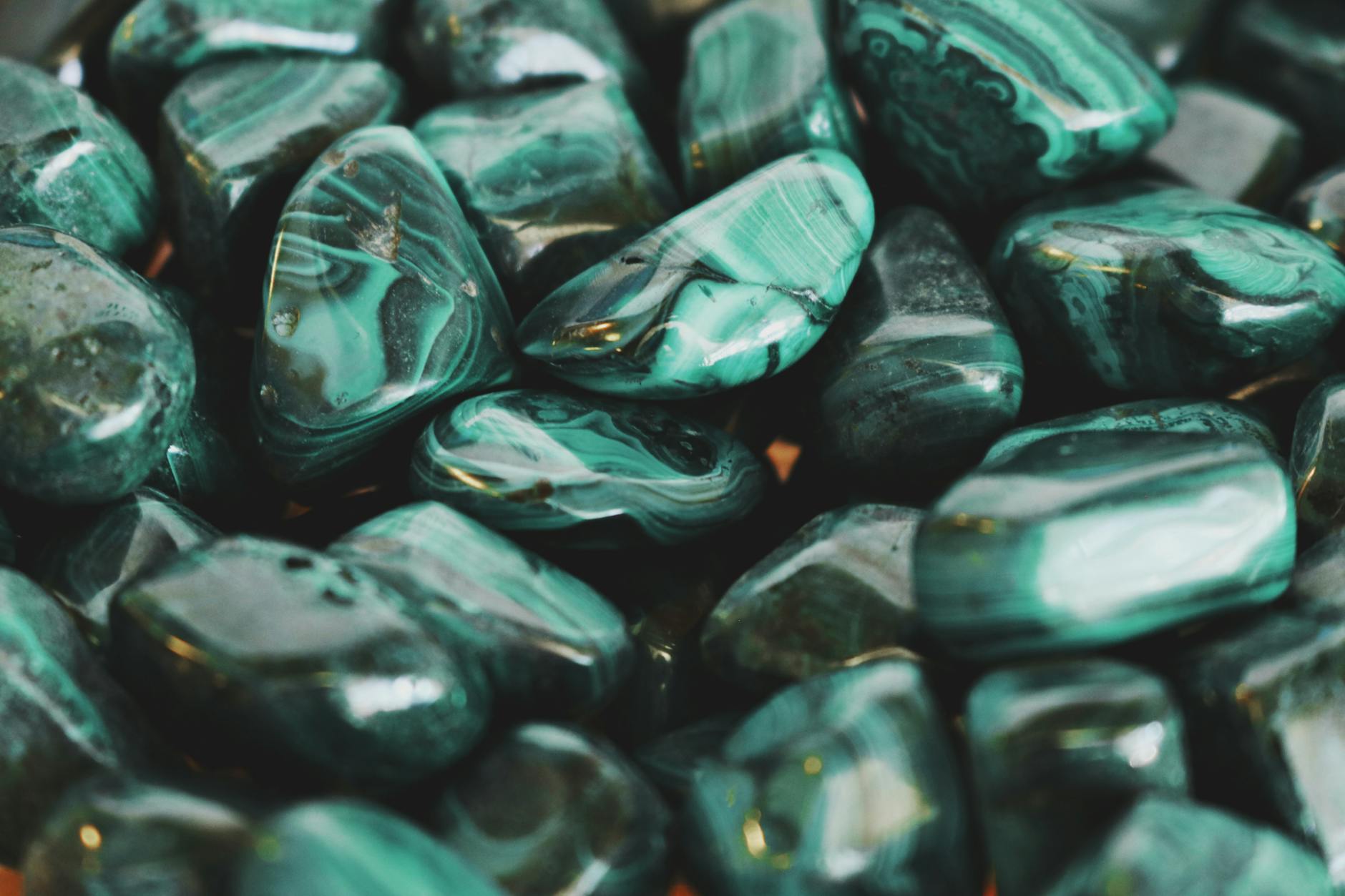
Real malachite stone forms in botryoidal (grape-like) clusters, creating swirls, circles, and irregular curves. It is chaotic and organic.
Fake Malachite: Often features straight, blocky stripes. If the stone looks like someone painted uniform black and green lines, it is likely polymer clay. Real malachite rarely has pure black distinct lines; the dark parts are usually a very deep forest green.
2. The Temperature Test
Genuine crystals are cold to the touch and take time to warm up in your hand. Plastic or polymer clay fakes will feel room temperature immediately and warm up quickly. This is a quick test you can do anywhere.
3. Specific Gravity (Weight)
This is the most definitive test. Malachite is a copper carbonate hydroxide mineral, making it significantly heavier than glass or plastic. It has a specific gravity (density) of approximately 3.6 to 4.0. In contrast, polymer clay or plastic usually sits around 1.3 to 1.8.
If you pick up a piece of malachite jewelry and it feels surprisingly light—like a plastic bead—it is almost certainly a fake. For detailed mineral data, you can check authoritative databases like Mindat.org.

Material Safety & Hardness
Authenticity isn’t just about value; it’s about safety. Because genuine malachite contains a high percentage of copper, raw dust can be toxic if inhaled or ingested. However, polished stones and jewelry are generally safe to handle and wear. Just don’t grind them down or put them in your mouth.
In terms of durability, malachite is relatively soft, ranking only 3.5 to 4.0 on the Mohs hardness scale. This makes it susceptible to scratching. You can verify these hardness ratings on educational sites like Geology.com.
Quick Tip: Because it is soft and sensitive to acid, never clean malachite with ultrasonic cleaners or harsh chemicals. Stick to a soft cloth.
Summary: Authentic Identification
If you are learning to spot a fake in other gemstones, the skills are similar: look for nature’s imperfections.
- Look: Swirls and circles (Real) vs. Straight stripes (Fake).
- Feel: Cold and heavy (Real) vs. Warm and light (Fake).
- Colors: Deep greens to light greens (Real) vs. Green and flat black (Fake).